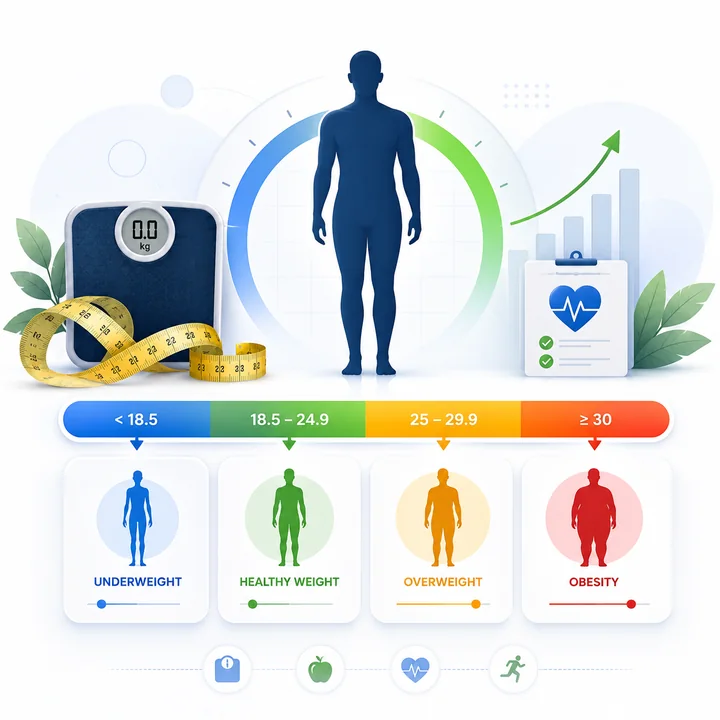
BMI chart and range guide
Adult BMI Categories and Ranges
A BMI result is sorted into a range — underweight, healthy weight, overweight, or one of the three obesity classes — to show roughly where it sits among adults of the same height. These ranges are screening references, not diagnoses, and they apply to adults aged 18 and older. The chart below shows each range and what it does, and does not, tell you.
Adult BMI chart and category ranges
The BMI chart below groups adult results into categories based on height and weight. It can help place a BMI calculator result into a general BMI range, but it does not diagnose health.
16
18.5
25
30
40+
On this BMI chart, the numbers mark where each adult BMI range changes, on a scale from 16 to 40+.
UnderweightBelow 18.5
Healthy Weight18.5 – 24.9
Overweight25.0 – 29.9
Obesity30.0 or higher
i
BMI uses height and weight. Read more about the BMI formula and why it does not directly measure body fat, muscle, bone, or water.
Adult-use note
These BMI categories are intended for adults aged 18 and older. People under 18 should be assessed using age- and sex-specific growth references rather than adult cutoffs. Pregnancy also requires a different clinical assessment.
What each category may mean
Underweight
BMI below 18.5
Weight is low relative to height. Because BMI does not directly measure body fat, it cannot show whether this reflects build, nutrition, or an underlying condition. Interpretation depends on factors BMI leaves out, and one reading is not a diagnosis.
Healthy Weight
BMI 18.5 – 24.9
Weight sits within the range used as a general reference for adults. Since BMI does not directly measure body fat, a result here does not confirm good health on its own — diet, activity, and medical history all matter, and a single reading is not a diagnosis.
Overweight
BMI 25.0 – 29.9
Weight is above the general adult reference range for height. BMI does not directly measure body fat, so it cannot separate muscle from fat — a muscular build can place a result here. What it means depends on other health information, and it is not a diagnosis.
Obesity
BMI 30.0 or higher
This range is grouped into three classes and is associated with higher health risk across populations. That is a general pattern, not a statement about any individual: BMI does not directly measure body fat, interpretation depends on other measures, and a result here is not a diagnosis.
Obesity classes
For adults with a BMI of 30 or greater, obesity is often grouped into classes.
Class 1 Obesity
30.0 – 34.9
Class 2 Obesity
35.0 – 39.9
Class 3 Obesity
40.0 or higher
Important context

- BMI is a screening tool, not a diagnosis.
- BMI does not directly measure body fat.
- BMI does not separate muscle, fat, bone, or water.
- BMI may be less useful for athletes, very muscular people, older adults, pregnant people, and some other groups.
- A healthcare professional can help interpret a result in context.
How to use the BMI categories chart
1
Calculate your BMI
Enter your height and weight in the free BMI calculator to get a number in metric or imperial units.
2
Find the matching range
Locate that number in the chart above to see which range it falls into.
3
Read the limitations
Check what the range does not capture, and weigh it alongside body composition, activity, and medical history. Our guide to what your BMI result means walks through this step by step.
Common questions about BMI categories
Is a BMI of 25 overweight?
Yes. The overweight range starts at 25.0, so a BMI of exactly 25 falls just inside it. A value sitting on a boundary is not meaningfully different from one just below it, and it says nothing on its own about body fat or health.
What are the three obesity classes?
Class 1 covers 30.0 – 34.9, Class 2 covers 35.0 – 39.9, and Class 3 covers 40.0 or higher. The classes simply subdivide the obesity range; they are not severity diagnoses.
Are BMI categories the same for children?
No. These ranges apply only to adults aged 18 and older. People under 18 are assessed with age- and sex-specific growth references, because height and body composition are still changing. Adult cutoffs do not transfer to them.
Can athletes have a high BMI without excess body fat?
Yes. BMI uses only height and weight, so it cannot tell muscle from fat. Muscular people can land in the overweight or obesity range while carrying little body fat, which is one reason BMI works better as a screening tool than a verdict. See the BMI questions and answers for more.

This content is for adults 18 years and older and is intended for informational purposes only. It is not a substitute for professional medical advice, diagnosis, or treatment.
Ready to check your BMI?
Use the calculator as a quick starting point, then read your result with context and individual needs in mind.
How this content is maintained
T9 BMI Check is an educational resource for adults. BMI is a screening tool, not a medical diagnosis, and the information here is general rather than personalized medical advice. We research our content against trusted public-health sources, work to keep it factually accurate, and review it periodically. For guidance about your own health, please consult a qualified healthcare professional.
References
Prepared and maintained by T9 BMI Check
Last reviewed against the cited sources: July 16, 2026