
BMI result guide
What Your BMI Result Means
A BMI result is one number that relates your weight to your height. On its own it does not say whether you are healthy — it shows where your result sits within the reference ranges used for adults aged 18 and older. This guide explains how to read the number, what your category and healthy weight range represent, and which limitations to keep in mind.
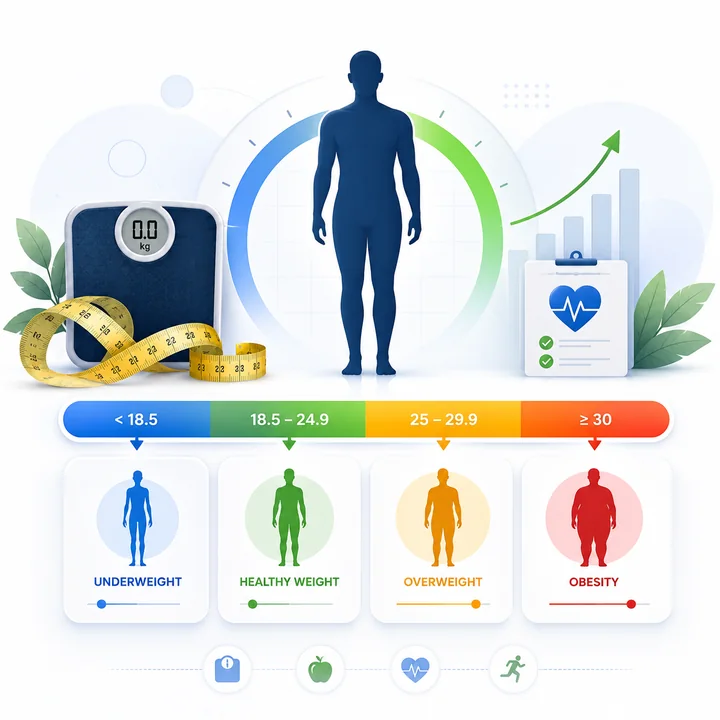
How to read the number
Match your result with the adult reference ranges below. Whether you calculated in metric or in imperial units, the BMI number itself reads the same way. For the full chart with explanations of every range, see the adult BMI categories guide. If you want to see exactly how that number is produced, the BMI formula guide with metric and imperial examples walks through the calculation step by step.
What the category means
Underweight
Your weight is below the adult reference range for your height. This is a screening signal to look further, not a conclusion: build, nutrition, and health history all shape what a low result actually reflects.
Healthy weight
Your weight sits within the range used as a general adult reference. That is a reassuring starting point, but one number does not describe your full health — habits, fitness, and medical history still matter.
Overweight
Your weight is above the general reference range for your height. Because BMI cannot separate muscle from fat, a result here is a prompt to look at the wider picture rather than a verdict about your body.
Obesity
Results of 30.0 or higher are grouped into three classes and are associated with higher health risk across populations. For any individual, what the number means depends on context a screening measure cannot capture.
What the healthy weight range shows
Alongside your BMI, the BMI calculator shows an estimated healthy weight range for your height. It is calculated from the adult BMI reference range (18.5 – 24.9) applied to your height — nothing more. It is an informational reference, not a target: it does not mean every person should aim for a precise weight inside it, and it does not account for body composition, age, or individual health circumstances. For a closer look at how that range is calculated and what its limits mean, see the healthy weight range guide.
What BMI cannot tell you

- Where body fat is distributed — waist measurement adds information BMI cannot provide.
- How much of your weight is muscle and how much is fat.
- How bone structure and frame size shape your weight.
- How body composition changes with age — results in older adults may need additional context.
- Your individual health context: history, habits, and other measurements a professional would consider.
For a closer look at these limitations — including athletes, aging, and pregnancy — see the BMI limitations guide.
Example results
Example — metric
An adult who is 1.75 m tall and weighs 70 kg has a BMI of about 22.9, which falls in the healthy weight range. This is an illustration of how the number is read, not advice for any individual.
Example — imperial
An adult who is 5 ft 6 in tall and weighs 160 lb has a BMI of about 25.8, which falls in the overweight range. Again, this is an example of reading the scale — not a judgement about a real person.
What to consider next
Common questions about BMI results
Is a BMI of 25 considered overweight?
Yes — the overweight range starts at exactly 25.0. A value on the boundary is not meaningfully different from one just below it, and on its own it says nothing about body fat or health.
Is a healthy BMI always proof of good health?
No. A result in the healthy range is a favourable screening signal, not proof. Nutrition, activity, sleep, and medical history are not captured by the number.
Can an athlete have a high BMI?
Yes. BMI cannot tell muscle from fat, so muscular people can land in the overweight or even obesity range while carrying little body fat.
Does BMI apply to children or during pregnancy?
No. These adult ranges apply from age 18. Children and teenagers are assessed with age- and sex-specific growth references, and pregnancy requires a different clinical assessment.

This content is for adults 18 years and older and is intended for informational purposes only. It is not a substitute for professional medical advice, diagnosis, or treatment.
Ready to read your own result?
Calculate your BMI, then come back to this guide to place the number in context.
How this content is maintained
T9 BMI Check is an educational resource for adults. BMI is a screening tool, not a medical diagnosis, and the information here is general rather than personalized medical advice. We research our content against trusted public-health sources, work to keep it factually accurate, and review it periodically. T9 BMI Check is an independent informational website and is not affiliated with or endorsed by the organizations cited. For guidance about your own health, please consult a qualified healthcare professional.
References
- World Health Organization — Obesity and overweight
- CDC — Adult BMI Calculator
- NHLBI — Calculate Your BMI
- MedlinePlus — Body mass index (BMI)
Prepared and maintained by T9 BMI Check
Last reviewed against the cited sources: July 17, 2026